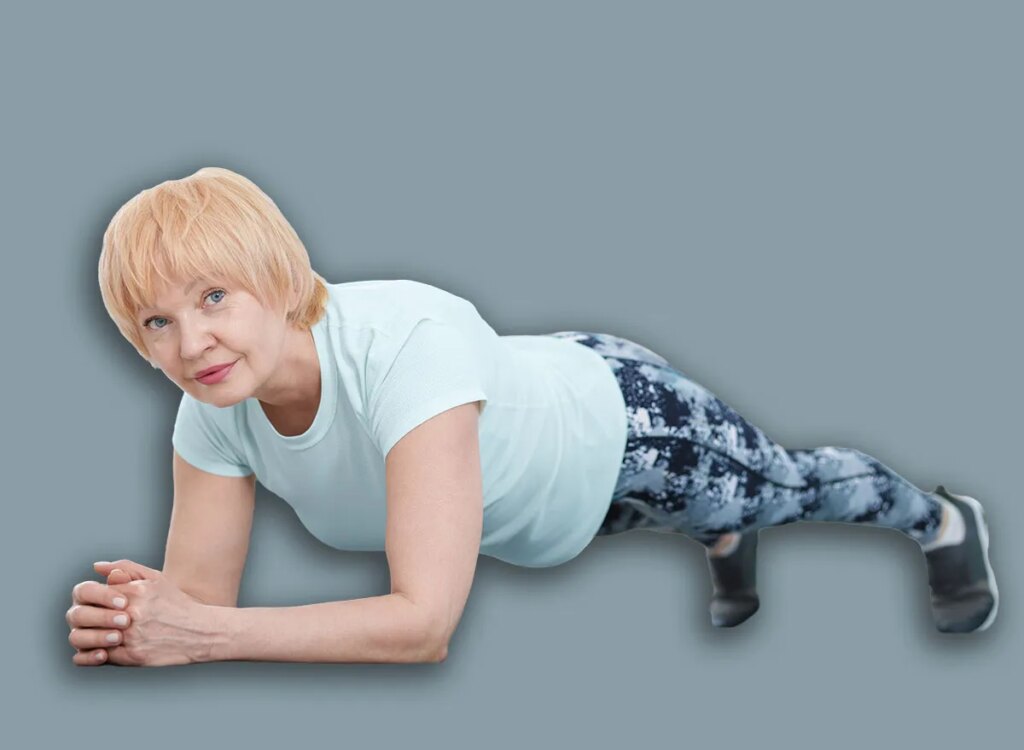

Stiff joints flaring up after 60? Skip the leaping jacks and get started with those 4 strikes
Stiff joints after 60 don’t generally want extra have an effect on; they want higher coordination. As a motion specialist, I paintings with shoppers each day who assume the solution is leaping into more difficult aerobic when what their frame in reality wishes is the other. Leaping jacks have their position, but when your sacrum isn’t shifting how it must, all that bouncing is solely dumping power into joints that may’t soak up it. Those 4 gradual workouts repair the small, managed actions your frame must care for power correctly, so you’ll transfer higher with out beating up your joints.
Why Leaping Jacks Aren’t the Resolution But
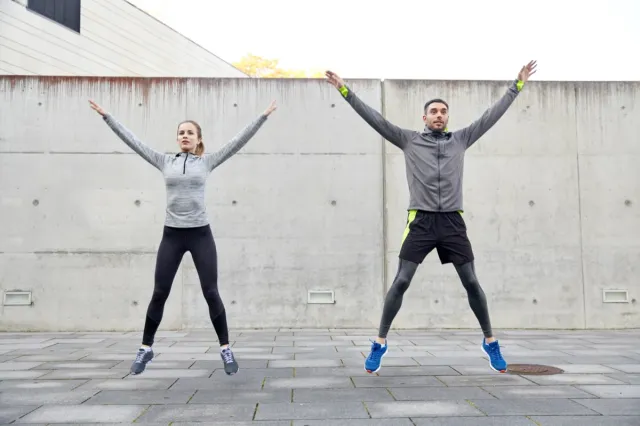
The query is, must you be doing leaping jacks as a part of your health regimen? I’d say sure, however perhaps now not reasonably but. Leaping jacks are nice for normal cardiovascular health, they’re a gradual creation to plyometric paintings, and so they fortify your frame within the frontal airplane.
Then again, leaping jacks create a large number of have an effect on, and that power must be allotted someplace. Your joints are answerable for dealing with that power. So when you’ve got deficient proprioception, deficient vary of movement, and even deficient alignment, you’re now not distributing power; you’re dumping it into the joints. And that’s the place the disorder begins.
The Sacrum Downside No one Talks About

One of the crucial essential buildings for dealing with forces on your frame is your sacrum. Your sacrum is a triangle bone, and it sits on the base of your backbone. It has 4 foramina, or holes, on each and every aspect the place the nerves pop out. Those nerves feed into your pelvic ground and into your decrease limbs. So the sacrum’s task is to distribute power from the bottom up and from the highest down.
The sacrum is suspended in a community of ligaments. They attach on your pelvis and on your lumbar backbone. After I’m speaking in regards to the connections to the pelvis, I’m particularly referring on your ilium. This is known as your SI joint, or your sacroiliac joint.
The sacrum doesn’t want giant motion. It wishes small, delicate, managed movement, and we name those micro-movements. When you’ve been following me, that micro-movements decide the macro-movements. Those small actions mixed make the huge actions of the frame.
The Trampoline Analogy
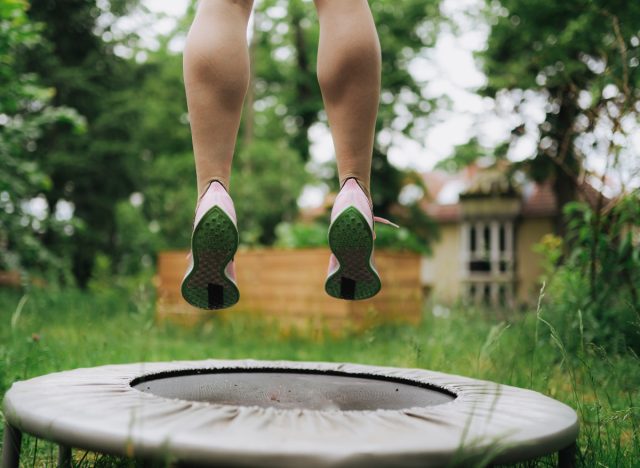
I love to think about the sacral house as a trampoline, the place the sacrum itself is the phase you bounce on. The ligaments connecting the sacrum to the pelvis and the decrease again are just like the springs of the trampoline.
When it’s operating smartly, it provides you with resilience, spring, and environment friendly power switch. But if the sacrum will get caught, generally in an aspect bend or a rotation, it stops shifting how it must. Now, as an alternative of simply distributing power, it begins dumping that power into different spaces of your frame.
That’s while you begin to see ache across the sacrum, hip discomfort, low again tightness, adjustments in gait, and occasionally even a useful quick leg. Through the years, that ends up in joint breakdown, ligament and tendon pressure, and greater rigidity at the lumbar backbone.
How Your Drive Machine Works

Right here’s the place folks generally tend to leave out it. The sacrum doesn’t paintings in isolation. It’s a part of a power gadget. You will have the diaphragm on best and your pelvic ground at the backside. What sits in between the ones two primary forces is the sacrum.
Those buildings paintings in combination to control power within the frame. There are ligamentous and fascial connections working from the pubic bone within the entrance to the coccyx or tailbone within the again. That ligament runs from the pubis the entire approach into the coccyx. The ones buildings combine at once along with your pelvic ground.
Be mindful, your pelvic ground is answerable for power legislation, bladder and bowel serve as, and strengthen of your reproductive organs. So it has as a way to contract and loosen up at suitable occasions.
In case your sacrum will get caught, it creates a torsion via that ligament and thru the ones fascial connections. That torsion transfers at once into your pelvic ground, and now your pelvic ground can’t reply correctly. On the identical time, in case your respiring is off, in case your diaphragm isn’t shifting smartly, you lose right kind power keep an eye on from the highest down. Now you’ve were given disorder from above and disorder from underneath. It all meets proper on the sacrum.
Now take that gadget and upload leaping jacks. Repetitive, prime have an effect on, no keep an eye on. That power is touring directly via a gadget that already isn’t managing power smartly. It’s like leaping on a trampoline that’s asymmetric. If one aspect is just too free, you don’t get any rebound. If one aspect is just too tight, you get started stressing the springs. On your frame, the ones springs are the ligaments. So as an alternative of bettering motion, you’re expanding rigidity, rigidity, and reimbursement.
As a substitute of beginning with have an effect on, right here’s what I do with my shoppers. I remind them that the objective isn’t depth. It’s restoring proprioception, restoring joint area, and power keep an eye on. When your sacrum, diaphragm, and pelvic ground are all operating in combination, your frame can in any case distribute power how it used to be designed to. That’s what means that you can transfer smartly with out beating up your joints.
Listed below are my 4 favourite workouts to revive sacral serve as and reinforce each your motion talent and your pelvic ground well being.
Segment One: Fingers and Ft Sacral Stroll
This primary section teaches you to start up motion out of your sacrum and ilium slightly than dragging your legs. You’re finding out to boost, now not slide, which is the root of the whole thing that comes subsequent.
Muscle mass Educated: Glutes, hip stabilizers, deep core, pelvic ground
How you can Do It:
- Position each arms and toes at the ground in a seated place
- Carry your proper butt cheek and transfer it ahead
- Carry your left butt cheek and transfer it ahead
- Don’t drag or slide, raise out of your hip
- Use your arms for strengthen as you transparent area underneath the glute
- Proceed moving aspect to aspect for 5 to ten paces ahead
- Opposite path and do the similar factor, shifting backward
Shape Tip: Focal point on lifting the hip, now not pushing off with the foot. Your arms are there for strengthen, now not propulsion.
Segment Two: Fingers-on Shins
Disposing of your arms from the ground takes away a layer of strengthen and forces your sacrum and pelvic ground to do extra of the paintings. Transferring backward will really feel more difficult than shifting ahead, and that’s customary.
Muscle mass Educated: Hip flexors, glutes, deep core, pelvic ground
How you can Do It:
- Carry your arms off the ground and snatch your shins
- Stay your legs kind of in line, don’t allow them to open
- Carry your proper glute and foot, then transfer ahead
- Carry your left glute and foot, then transfer ahead
- Proceed for 5 to ten strides
- Repeat shifting backward
Shape Tip: If you’re feeling your self moving or sliding a bit, don’t concern about it. The objective is to progressively cut back that sliding as you construct keep an eye on.
Segment 3: No Fingers Sacral Stroll
Now you’re shifting with out the help of your palms in any respect. That is the place you in point of fact begin to really feel whether or not you’ve constructed the keep an eye on from the primary two levels.
Muscle mass Educated: Glutes, hip stabilizers, deep core, pelvic ground, stability gadget
How you can Do It:
- Unencumber your legs and let your palms grasp unfastened
- Carry your proper hip off the bottom and transfer ahead
- Carry your left hip off the bottom and transfer ahead
- Don’t scoot or slide, raise the hip with each and every movement
- Opposite path when you’ve moved ahead 5 to ten paces
Shape Tip: When you are achieving for the ground or your shins, return to section two till the motion feels managed.
Segment 4: Strolling on Your Sits Bones
That is probably the most difficult of the 4 actions. You’re strolling for your ilium, also known as your take a seat bones, with out a arms and no toes at the ground. Transferring backward here’s considerably more difficult than shifting ahead and calls for actual stability.
Muscle mass Educated: Deep core, pelvic ground, hip stabilizers, stability gadget
How you can Do It:
- Sit down upright with out a arms and no toes at the ground
- Carry one sitting bone and transfer ahead
- Carry the opposite aspect of the bone and transfer ahead
- Construct as much as shifting backward, which can really feel a lot more out of stability
- Grasp the primary 3 levels sooner than making an attempt this one
Shape Tip: Don’t rush into section 4. The backward path, particularly, calls for the root you inbuilt levels one via 3.
Keep away from Those Errors
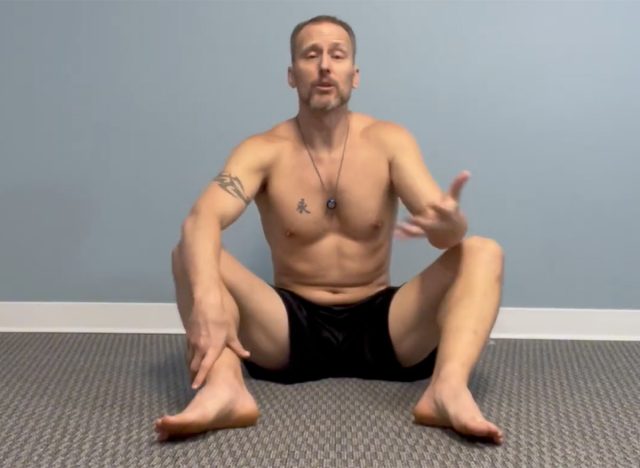
- Don’t slide or drag your hips. The entire level is to boost from the sacrum, now not scoot around the ground.
- Don’t skip the sooner levels. Segment 4 seems to be easy nevertheless it calls for the keep an eye on inbuilt levels one via 3.
- Don’t rush the backward path. Transferring backward is all the time more difficult and calls for extra proprioception. Construct as much as it.
- Don’t let your legs splay open in section two. Stay them kind of in line so the paintings remains on your hips and sacrum.
- Don’t chase depth. Those are micro-movements. The objective is keep an eye on, now not effort.